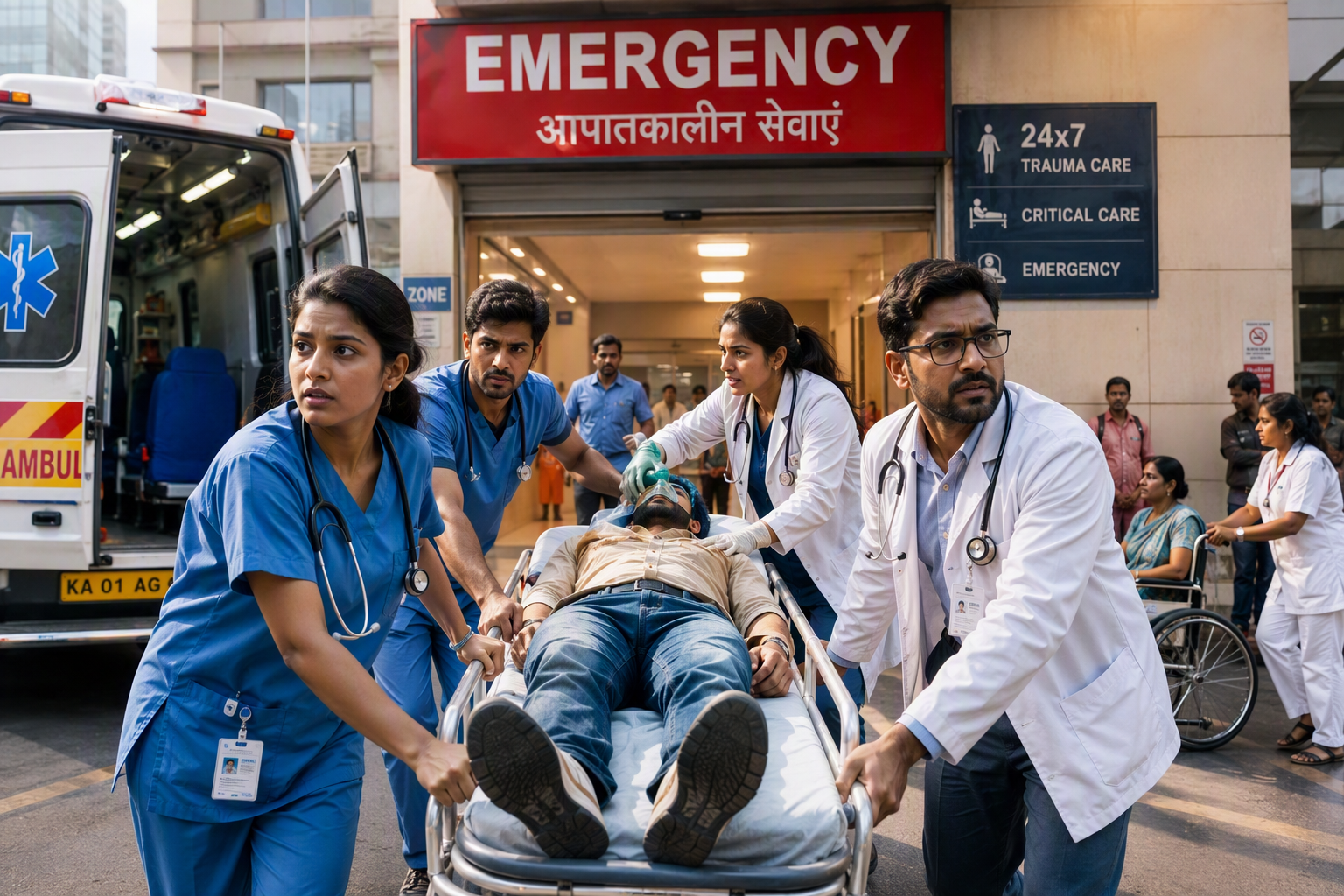
Key Highlights
- India’s healthcare system for emergencies has grown. But people still face big problems in getting emergency care on time.
- Ambulance services take time to get to a patient. Weak links in sending referrals also make treatment harder during medical emergencies.
- A lot of hospitals have emergency department spaces that are too crowded. There is not enough critical care for patients when they need it most.
- Patients who live in rural areas have to wait longer for help. There are also not as many trauma care options for them.
- The law gives people rights for emergency care. However, their safety can be at risk if rules are not followed well.
- Using new digital tools and telemedicine, along with a stronger emergency response system, could help patients feel better and improve urgent care.
Introduction
When someone has a heart attack, is in a road crash, or faces other medical emergencies, every minute counts. In India, emergency care is now a bigger part of the healthcare system. Still, many people do not get fast help when they need it most. Emergency medicine is better than before, but how patients get help can change based on where they live, how quickly transport gets to them, and if the right hospital is open to take them. To know more about these problems in patient care, it is good to see how the emergency care system started and where the delays begin.
Evolution of Emergency Healthcare in India
India’s emergency care system has seen many changes in the last few decades. In the past, the emergency spaces in the hospital were often just simple rooms. These places usually had interns or doctors who would take turns working. That kind of setup could not handle the higher demand or all the new injuries that kept happening. There was also a need for quicker critical care, and the old ways were not enough for that.
Over time, emergency medicine became a real part of the healthcare system. People started training in this area. Formal departments were set up. New emergency response efforts began to grow as well. These changes helped build what we know as emergency care today. But there are still many gaps that need to be filled.
Key Milestones in Indian Emergency Medicine
A big change happened in 1982. That was when the Association for Trauma Care of India began. It started an emergency medical service under the Golden Hour Project. This showed early on that quick, time-sensitive care can save lives. The move helped people see how important it is to have a more organized emergency care system. This pushed forward the idea of better emergency care for all, focusing on the golden hour and trauma care.
Another big step came in 2000 when the Society for Emergency Medicine, India, was set up. This helped to support modern emergency medicine. It got more people talking about training programs, how ready hospitals are, and how the country needs more skilled emergency physicians. It also pushed for some changes in medical education.
In 2009, emergency medicine became an official specialty for doctors after their basic studies in India. Later, the government said every medical college must have a department for emergency medicine by 2022. This was a crucial step to build up emergency care across the country and make sure there are more trained people to help in urgent situations.
Changing Patterns of Emergency Medical Needs
Emergency needs in India are now more difficult. The country has many problems like road injuries, infections, pregnancy issues, and more people getting sick from things that do not spread from person to person. These problems are not just regular visits to a doctor. A lot of these are critical cases. If there is a delay, people could get hurt more or lose their lives.
Think about the golden hour just after a bad injury or the first few minutes after a person has a cardiac arrest. During a heart attack or when there is a big injury, what you do early can help someone live. Emergency care must do more than just take in people. It needs to move fast, help keep people stable, and make sure they get to the right place without any mixup.
In the recent years, there have been more traffic deaths and growing pressure on hospitals. This has made it much harder to ignore these needs. Many people now need fast treatment, better ways to move patients between places, and stronger help before they get to a hospital. As the number of emergencies goes up, old hospital-only models do not work as well to handle things quickly.
Influence of Major Public Health Events
Major public health events have changed the way India thinks about getting ready for emergencies. Things like earthquakes, tsunamis, cyclones, city floods, hospital fires, and the COVID-19 pandemic showed how fast health services can get full. These times made it clear that planning for emergencies should not stay just inside hospital walls.
In times like these, the department of emergency medicine is at the heart of triage, surge response, and teamwork. In recent years, hospitals have seen how tough things get when they run low on beds, staff feel stressed, and there is no common way to expand help during disasters. The problems in daily emergency medicine became easier to see during these times.
India’s national disaster management authority gives hospitals an incident response system. This helps with planning and practice for disasters. This is important because natural disasters and big emergencies need everyone to work together. You cannot just make a new plan each time. A good system for disaster readiness helps emergency response work better. It also helps during normal times, like when the hospital gets a lot of people at once.
Structure of India’s Emergency Response System
India’s emergency response system brings together ambulances, call centers, district hospitals, higher-level hospitals, and emergency care providers in public and private sectors. While this seems like a good and broad set up on paper, it does not always work well in practice. Many emergency care services use separate channels. Their standards and abilities can be very different from each other.
This issue makes things hard for the whole health system. Many people go from one facility to another before they get the right help. During the pandemic, the use of regional command centres made it clear that better teamwork helps. It let people manage beds and the way patients move between places in a good way. To understand the health system, it can help to look at hospitals, pre-hospital care, and the steps policy experts take on their own.
public and private hospital networks
India’s emergency network counts a lot on district hospitals and the big public sector healthcare facilities. These public hospitals are the main place for care, especially if you want treatment that is not too costly. But many of these healthcare facilities have to deal with too many patients, not enough beds in the emergency department, and they often don’t have enough staff.
Private hospitals often do better in a few key areas. Reports show the systems in private hospitals for emergency surgery, practice drills, referral policies, checks, and how the staff talk to each other are stronger. In many places, private hospitals also have better medical equipment. They also have more clear steps to follow in the care they give. This can help give faster treatment to people and can make them feel more happy with the care they get.
The picture is still not all good or bad. The public sector gets most of the emergency referrals. It is often overwhelmed by the number of patients who come in. Private hospitals are not always fully a part of how referrals are made. This means the two can feel very separate. So, people may have to go from one place to another, instead of getting the help they need faster at the right center. A stronger link between the public sector and private hospitals would mean less confusion and less wasted time.
Role of Pre-hospital Emergency Services
Pre-hospital support is a key part of emergency care services. Before a patient gets to a hospital, ambulance services have an important job. They need to bring the patient quickly, help keep them stable, and talk clearly with the team in the hospital. When ambulance services do this well, early intervention helps improve patient safety and stop problems from getting worse.
India now has more ambulances in many places. The National Health Mission has thousands of Basic Life Support vehicles. But the system still has problems. Response times change a lot. There are not always trained emergency medical technicians in every ambulance or area.
This is important because a vehicle by itself is not enough for emergency care. A good emergency care service must have trained people, right tools, working ways to talk to each other, and a plan for getting help when needed. There are still many serious cases where people get to hospitals by private cars, not by formal emergency care services. This shows that people do not feel confident about the service, and the service does not work the same everywhere. If we have better care outside the hospital, it could save time when every minute matters most.
Recent Policy Initiatives in Emergency Healthcare
In recent years, India made some big changes in the area of emergency care. The country started PM-JAY under Ayushman Bharat to help more people get medical help. Emergency care is now seen as a key part of health for all people. This has made emergency systems an important part of the country’s health plans.
The ministry of health and family welfare also helps with big health steps that work with emergency plans. For example, ASHA workers in the National Health Mission help people in the community feel more connected. Tools that use digital tracking show how technology can help cut down on hospital stays that are not needed. These tools also help people know more about how the system works.
Another big step was starting 112 as one emergency number. This change helps bring many helplines into one system. When the pandemic happened, regional command centres also did important work. They helped keep track of where people could get inpatient care. These things show us why it is important to bring different services together now. If we do not have shared rules, stronger training programs, and clear referral pathways, there will still be hold-ups in the system.
Main Challenges to Timely Emergency Treatment
Why do so many people still miss getting fast help during medical emergencies? The main reasons are slow travel, busy hospitals, poor team work, and also not having enough skilled workers and tools in many places. These problems can hurt emergency care even before someone gets to a hospital bed.
Medical services often work on their own and not together. This makes response times go up and also leads to confusion that you can avoid. When there is a delay, it is not from one thing, but many things add up. These can happen in transport, triage, referral, or even in-hospital care. In the next sections, you will see the most common things that get in the way.
Delays in Patient Transportation
Transportation delays are still a big reason why people miss out on early treatment. Ambulance services are not always fast to get to where they are needed. Response times can go from about 10 minutes to up to 25 minutes. This can happen even when there are good ambulance services. In emergency cases, that extra time can make a difference between getting well and having lasting harm.
The problem in rural areas is the distance, fewer cars, and not enough staff. This makes moving the patient slower. A lot of people in these places still use private transport instead of emergency systems. That makes patients come in not stabilized, without any message sent ahead, and after losing time that can be important.
Public awareness plays a big role. If people do not trust ambulance services, or if they do not know how to reach them, they might not call for help. A better dispatch system and trained field staff can help a lot. GPS support and public education also make it easier to get help in the golden hour. If people get to the right place quickly, there is a better chance that they will survive.
Emergency Department Overcrowding
Emergency department overcrowding is one of the most obvious signs that the system is under stress. These emergency units were made to treat urgent and serious cases fast. But now, many people use them when they cannot get help anywhere else. The increasing demand means there are long waits. Beds stay full and patient care becomes much slower.
In India, the number of emergency beds in hospitals is low. There are only about 3% to 5% emergency beds out of all hospital beds. A lot of people get into the hospital through emergencies.
If there are not enough critical care beds and the way patients move in the hospital is bad, people stay longer in the emergency department. This can cause problems for everyone.
This is not just a problem for the emergency room. The way beds are managed all over the hospital has a role in this, along with issues with referrals and with getting people ready to leave the hospital. Some private hospitals might do a good job inside their own walls, but this issue shows up in both private hospitals and public ones. If people cannot move through the hospital more easily and if there is not better community care, then overcrowding will keep making emergency care slow for everyone.
Communication Gaps Between Agencies
Even when there are ambulances and hospitals nearby, people can face delays because of poor communication. In many states, people who provide medical help, ambulance services, and call centers often do not follow the same rules. This can make emergency response slow. It can also be hard to send a patient to the best place at the right time.
Inside the health care system, there is a problem with referrals. Smaller centers often try to take care of severe cases that are too much for them. Larger hospitals get these patients late, and do not have enough details about them. The department of emergency medicine may have to help and keep these patients safe. Some should have come sooner or to another place. This is a big issue in emergency medicine, health care, and the whole health care system.
Better coordination can help the emergency care system work much better. If there is a system for dispatch to be connected, everyone knows the rules for transfer, live bed tracking is used, and ambulances talk more with hospitals, then emergency care can be smoother. When people and groups share information fast, it lowers delays and stops people doing things twice. It also helps patients move in a safe and clear way.
Barriers Faced by Patients in Accessing Emergency Care
From a patient’s side, the path through emergency care can feel hard from the start. Many people worry about cost, need to travel far, face crowded hospitals, and feel lost inside the building. All these things can affect the quality of patient care. In different parts of the country, these problems are not the same for everyone.
Urban differences and gaps between regions play a big role in how people get emergency care. Someone living in a big city can find more hospitals. A person in a smaller town may have fewer choices and may wait longer to get help. To better see how the emergency care system works, you need to think about money, where people live, and how people get around in a hospital.
Financial Hurdles and Insurance Coverage
Money can get in the way very fast in emergency cases. Families often want care first and deal with paperwork later. But the fear of how much it will cost can change what people do and where they go. This is seen a lot when someone is taken to the private sector. The charges there can be too much for many families to handle.
India has worked to lower this pressure by giving more health coverage through programs like PM-JAY. Emergency care is a key part of the big goal, which is to make sure all people can get health care when they need it and not have to worry about money problems. This is a big step for the public sector and the others who take part in health care.
Even with coverage, there are still some problems when people try to get care. A patient might feel confused about who can get care, which place they should go, or how to get a referral. If a hospital is not part of the emergency system, having insurance might not mean you get quick care. Having help with costs is good, but it only really works well when the whole system is set up the right way.
Rural vs Urban Disparities
Where you live can change how quickly you get emergency help. People in rural areas might be far away from trauma centers, big hospitals, or good ambulance service. This means it can take more time for someone to come help. Response times can be longer if you have a serious injury, sudden sickness, or a problem with pregnancy. In these places, getting care often takes more time.
There are big gaps between cities when it comes to care. A city can have many hospitals, but the big number does not always help. Cities often deal with crowding, busy emergency rooms, and hospitals that are not all the same. So having care nearby is not enough by itself. What you need is to get to care that is ready for you, with open beds, the right tools, and people who know what to do, at the time you need help most.
The healthcare system has a hard time putting enough trained health care professionals in the places where they are needed most. This is a big problem in rural and semi-urban places. There are often even bigger gaps when it comes to emergency medicine physicians and those who help with trauma. Until things like staffing, transport, and networks for referrals all get better, where you live will still be a big part of your chances to survive.
Navigational Difficulties within Hospitals
Going to a hospital does not always mean you will get help right away. Sometimes, after you go in, you may face delays because help is hard to find. Families may not know where the emergency department is located. They may feel lost about how to finish needed admission steps. Some people do not know which desk is for urgent cases and who to talk to first.
Triage systems matter a lot in this place. If the triage systems are not there or do not work well, patients who have serious illness may wait too long with those who do not have urgent needs. This is a problem for patient safety, especially if the staff feel pressure or the department is too full.
The layout and how ready a hospital is can change how fast care happens. Some hospitals do not have enough ambulance unloading space. Some do not have easy access to point-of-care labs or the right medical equipment and drugs to be used during a sudden emergency. When it takes a long time to move around in the hospital, the full emergency process gets slow. Clear signs, using the same way of sorting patients, and better ways to manage the steps can help both patients and people who care for them.
The Role of Ambulance Services in India
Ambulance services are the first step in emergency care. They take people from their homes, roads, or small clinics to a hospital. This is really important when there is a medical emergency and every minute counts. Over the years, India added more ambulances and emergency numbers. But, how well these ambulance services work is still not the same everywhere.
The work that emergency medical technicians do is as important as the ambulance. A good checkup in the field, basic care, and handing the patient over faster can help people before they get to a hospital. If you want to see how these services work, you need to look at the types of services, how people work together, and the technology used by medical technicians.
Types of Ambulance Services Available
India has many different ambulance services in both the public sector and private sector. A lot of the vehicles are given by government-supported groups, like those under the National Health Mission. Transport systems are also run by private providers, hospitals, and other local operators. But, the service and how ready they are can change a lot from one to another.
Not every ambulance gives the same kind of support. Some are just made to move people from one place to another. Others have tools and team members to help keep a person stable while they travel. This is important for people who have trauma, a stroke, or trouble breathing. They may need quick care as they go, not only a way to get somewhere.
Common service types include:
- Basic Life Support ambulances have the core medical equipment needed to help keep patients stable. These are used for day-to-day emergency trips.
- Public sector ambulances are part of the government health networks. They connect with state-supported response systems.
- Private sector ambulances work with hospitals or are run by other providers. The cost and service you get from them can vary.
- There are also vehicles for critical transfers. They are for sicker patients who need more monitoring when moving between places.
Coordination with Hospitals and First Responders
Ambulances can do a good job when they are closely linked to hospitals and first responders. This helps because emergency medical technicians are able to tell the team waiting at the hospital important things, pass on information about vital signs, and pick the best place for the patient to go, all based on what is needed. When medical technicians keep in touch like this, response times after arrival can get better, and the handover is also done in a good way.
At this time, India still has a problem with different parts of the emergency care system not working well together. A lot of providers use different call setups and do not have the same referral rules or places where patients go. Because there is no strong plan for teamwork, many ambulances move patients between several facilities instead of taking them straight to good emergency care providers. This can use up time and add risk, especially when there is a severe emergency where speed is very important.
Better links can help improve patient outcomes in simple ways. Shared dispatch platforms, support from tele-consult, clear rules for transferring, and talking directly between field teams and hospitals can help remove doubt. When teams outside the hospital and at the hospital work as one, treatment is faster, safer, and more on point.
Technological Advancements in Ambulance Operations
Technology is changing how ambulance services work in India. The main advantage is not just one tool but having better connection in the emergency response system. GPS tracking, digital dashboards, and command centers help people find the closest vehicle. These tools also let them know which hospitals have room and cut down on wasted travel.
This new way to connect the emergency response system will make emergency response much faster and better for all people.
Telemedicine is a helpful tool. It lets field teams speak to hospital experts before they get there. This is good for strokes, trauma, and other emergencies where time matters a lot. In the future, artificial intelligence and machine learning could help us predict problems, manage bed use, and send cases to the best place.
Here is a simple look at these new technologies:
| Technology | How it can support ambulance operations |
|---|---|
| GPS-enabled dispatch | Helps send the closest ambulance and improve traffic routing |
| Telemedicine links | Allows live guidance between field teams and hospitals |
| Artificial intelligence | Supports predictive planning, triage support, and resource use |
| Regional command centres | Track calls, beds, and ambulance movement across areas |
| Digital dashboards | Improve visibility for referrals and transfer decisions |
Legal Rights and Protections for Emergency Patients
Emergency patients in India do have some protection. The right to life, found in Article 21, has been important when people talk about the right to medical care. This is true for emergency cases. In short, no one should be turned away from lifesaving treatment when they need urgent help.
Even when the law says you have rights, things do not always go well in practice. Patient safety can get worse when there are too many people in the hospital. This can happen when people cannot get referrals, or when staff do not have the help they need. To see the full picture of the law, you need to look at how care works right now, recent policy changes, and the everyday problems that come up.
The Right to Immediate Medical Care
The main idea is easy to understand. If a person has a medical emergency, they should get help right away. In India, the right to emergency care is linked to the value of life in the constitution. This means everyone must get medical help quickly when a delay could lead to death or major harm.
For people, urgent care must be given without any refusal or wait that can be avoided during a crisis. The health care system needs to make sure it puts stabilizing the patient first. A health care system should not let paperwork, money talks, or confusion with referrals slow help in emergencies. Emergencies need fast action.
But in real life, things are not always smooth. Patient safety can still be at risk if hospitals do not have enough beds or staff. A lack of clear plans for moving patients can also make things worse. So even if you have the right to care, what you feel as a patient will come from how fast the hospital network, ambulance, and emergency department work for you at that time.
Recent Legislative Developments
Recent changes have made emergency care more important in India’s health plans. Now, emergency medicine is seen as its own specialty. Hospitals and medical colleges have to set up emergency departments. This gives emergency care stronger support in the system. It is easier for people to get their legal rights met when the system is ready and built for that.
The ministry of health has helped with big changes in the country’s health system. These changes link to emergency access in an indirect way. They also try to give more people health services and help train health workers. The actions on their own do not give a strong legal shield. But, they do help put emergency care in a better policy setup.
There is more pressure now for the public sector and private hospitals to care for emergency patients before sending them somewhere else. As the department of emergency medicine gets bigger in these places, it may be easier to put legal rights into practice. Real safety for patients happens when the system, staff, and responsibility all work together.
Implementation Challenges in Practice
Here is the hard part: even when people want to do the right thing, putting it into practice can be hard. India’s healthcare system has big gaps in how many beds or doctors are there, and in how well people work together. So, even if emergency cases are supposed to get care right away, there can still be waits. Crowded hospitals, problems with getting there, or not having needed tools can mean treatment is pushed back.
Emergency medicine has problems with not having enough people working and skill gaps. In many places, junior staff members have to handle tough situations without enough help from more senior staff. Language barriers, stress, and even violence toward staff can make it even harder for everyone to talk well. These problems can put patient safety at risk in emergency medicine settings.
The chance here is to make sure what is promised in the law and in policy happens every day. Setting clear rules for transfers, having enough staff, checking quality of care often, and helping people talk to each other would make care better. Rights really help people only if there is a system that works fast, is fair, and does the same thing for every patient.
Assessing the Quality of Emergency Medical Care in India
How do we decide if emergency medical care in India is good? We often look at several things, like the number of staff, the tools and equipment, how well the team is trained, the number of emergency beds, the rules they follow, checks on their work, and how patients move through the system. These things show how fast emergency care services can help and how well critical care is given. They also let us know the quality of care people get in emergencies.
Recent checks have found big gaps, mostly in district and government centers. At the same time, there are some hospitals that have stronger systems and better patient outcomes. To know what works and what does not, it helps to look at standards, common problems, and what patients feel during care.
Current Standards and Accreditation
Quality gets better when hospitals use clear rules. In emergencies, this means there are trained staff, safe triage plans, good equipment, practice drills, checks, and referral steps in place. Reports from India show that hospitals with proper academic and emergency systems usually give faster care and talk better with people.
Accreditation and having rules inside a place matter because they help turn what people want to do into things everyone can do again and again. A place with better training programs in emergency medicine will often have better ways to handle patient flow, be ready for big problems, and always try to get better. These things help emergency medicine physicians and their teams handle tough days in more steady and reliable ways.
Even so, the standards for care are not the same everywhere in the country. A lot of hospitals, like smaller government ones, still have big gaps in equipment and staff in the emergency units. They also have problems with being ready for emergencies. This means the quality of care is not always the same. So, how good the emergency treatment is can depend a lot on which hospital a patient goes to first.
Key Issues Impacting Quality
There are several problems that keep the quality of care in India’s emergency units low. One big problem is with staffing. A hospital may have enough doctors and nurses as a whole. But there are not always enough people working in the emergency part. A lack of trained medical technicians and paramedic support makes the work harder for everyone in these situations.
Equipment is another problem. Some places do not have all the medical equipment they should have. This issue is worse in smaller government hospitals. When there is no good supply of this equipment, patient care is not as good. The staff have to slow down and make hard choices when they see severe cases. With better medical equipment, they could give better care to patients.
The emergency care system has problems with weak triage, too many people, and not enough working together when sending patients to different places. These are things that affect the whole system, not just one hospital. When transport, taking in patients at hospitals, and managing beds for people who stay all struggle, patient care goes down at every step. To make emergency care better, we need to improve the whole chain, not just the emergency room.
Patient Outcomes and Satisfaction Levels
Patient outcomes get better when care is fast, well-staffed, and runs smoothly. Injured patients and people with sudden illness improve most when they are checked fast, made stable early on, and sent to the right place for care without slow downs. If there be a hold-up at any step, it can make recovery harder and increase risk.
Satisfaction often comes from good communication and quick care. Hospitals that have clear emergency systems, focused referral steps, and better ways for caregivers to talk with people often see better patient outcomes. These hospitals also hear that patients feel more satisfaction. This goes beyond just making people feel good. People are more likely to trust the health care system when they feel looked after. It shows that how much you feel safe has a lot to do with how a health care team works with you.
Patient safety can get worse if the emergency department is too full, hard to find your way in, or does not have what is needed. Families often look at how long they wait, the information they get, and if things seem in order to judge the care. On the other hand, doctors and nurses care about keeping people alive and stable. Both of these things are important. A better way of doing things in the emergency department helps not only with health results, but also makes people feel that the whole emergency process is working well.
Innovations and Future Directions in Emergency Case Management
India’s future in emergency care will not just need bigger hospitals. It will depend more on better teamwork and fast action. New digital tools can be used to track available beds, help guide ambulances, and support quick decisions during an emergency. This is important, because early intervention often needs good information reaching the right people as fast as the patient does.
Telemedicine, artificial intelligence, and stronger disaster plans are all part of this change. People already talk about using these ideas for pre-hospital care, moving people between hospitals, and handling times when many people come to the hospital at once. The next step is to make these things work in real life and connect them across the whole emergency process.
Digital Tools and Telemedicine Integration
Digital tools can help emergency care work as one team. These tools stop things from being split into many parts that do not talk to each other. There are bed tracking systems, ambulance maps, and referral dashboards. These can show where there is space in real time. When you can see this right away, it cuts down on wait time. There is less guessing and fewer moves from one place to another.
Telemedicine gives more help to people in the field and in smaller hospitals. They can talk with specialists before sending the patient to a bigger hospital. This helps keep the continuum of care strong, especially when quick choices are needed for stroke, accidents, or bad breathing problems.
Regional command centres used during the pandemic showed that having a central place to watch and guide things is very helpful. They made it easier to manage times when more patients arrived or when there were only a few beds. If these regional command centres are made bigger and tied into the usual emergency response, India can make a better and quicker network. This will help handle daily emergencies and big disasters more smoothly.
Artificial Intelligence and Smart Triage
Artificial intelligence is set to help make emergency response better for many people at once. In emergency medicine, AI can be used to help look ahead with predictive modeling. It also helps watch over patients and helps with the work done inside the emergency department. This is important because hospitals have to act fast. Many times, they have less staff on hand and too many people in crowded spaces.
One way this can help is through smart triage. If digital tools show the staff which patients are at high risk sooner, they can know who needs care first. This means they can handle critical care cases better and can also send vital help to where it is needed, faster. AI can also help run real-time bed management. This can help hospitals act quickly when there is a sudden need and can cut down on long and dangerous waits.
India is working toward this future. The path is clear. If used the right way, artificial intelligence can help connect ambulances, control centers, and hospitals. This would build a smarter decision network. The goal is not to take away jobs from doctors or nurses. It is to help teams spot urgent cases faster and use what they have in a better way.
Improving Disaster Preparedness
Disaster preparedness can help make routine emergency care stronger. India has to deal with natural calamities like cyclones, floods, tsunamis, earthquakes, and fires. There are also public health problems, such as pandemics. Every event shows if the emergency response system can grow fast and not break down.
Hospitals should use the incident response framework from the national disaster management authority. A hospital can do regular practice drills, citywide exercises, and crisis planning to get ready for a sudden rush of patients. This helps all types of facilities, both public and private, feel more prepared. These steps are important. Disasters usually show the same problems we see every day in hospitals. These are things like crowding, not enough staff, and trouble working together.
Training courses are very important here. Staff have to get ready for more than just trauma care and resuscitation. They need to know how to handle busy times, talk clearly with others, and understand their jobs when things get tough. Better training for disasters will help everyone feel more sure of themselves, work better as a team, and make the whole system stronger. This support will also help their regular emergency work feel and be better every day.
Conclusion
India has come a long way in emergency care. Still, there are barriers that make it hard for people to get treatment on time. Things like crowded hospitals, slow transport, and money problems can keep many from getting help when they need it. To fix this, there must be more than one solution. New ideas, like telemedicine and tools powered by AI, can help improve the way we deliver emergency care.
As we keep working to look after our people, it is important for every person and family to know about their rights and which resources are out there. If you want advice on how to find your way through emergency care in India, you can ask for a free consultation any time. Your health and safety matter to us.
Frequently Asked Questions
What steps can families take to get faster emergency healthcare in India?
Families can get help faster if they spot warning signs early. They should use formal emergency services when these are there. Go to the nearest good hospital as soon as they can. Knowing the emergency response number can help a lot. Keep important records ready. Ask for urgent triage when needed. Doing these things will make response times better and help with patient safety.
Are all Indian hospitals legally required to provide emergency treatment?
Indian citizens have legal rights that protect their right to life. This means people can get emergency care in urgent times. In real life, hospitals need to give quick help to stabilize patients. But the quality and speed of health care can still change. It depends on how many staff there are, the hospital systems, and what each place can do.
How has emergency healthcare in India improved in recent years?
In recent years, emergency healthcare in India has seen growth. Emergency medicine is now a recognized field. More people get training in this area. There are more emergency departments, and the number of ambulances has gone up. The 112 emergency response system and better command centers also help.
These steps make medical services stronger. But, there are still big gaps. A lot needs to be done for critical care and better coordination in the system.