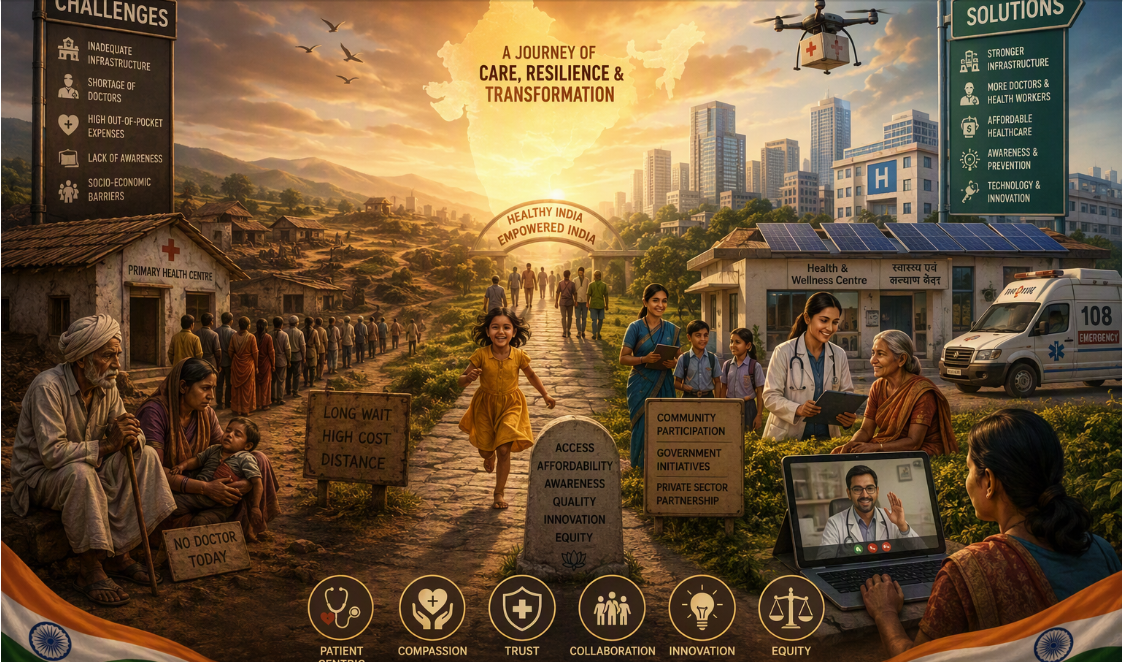
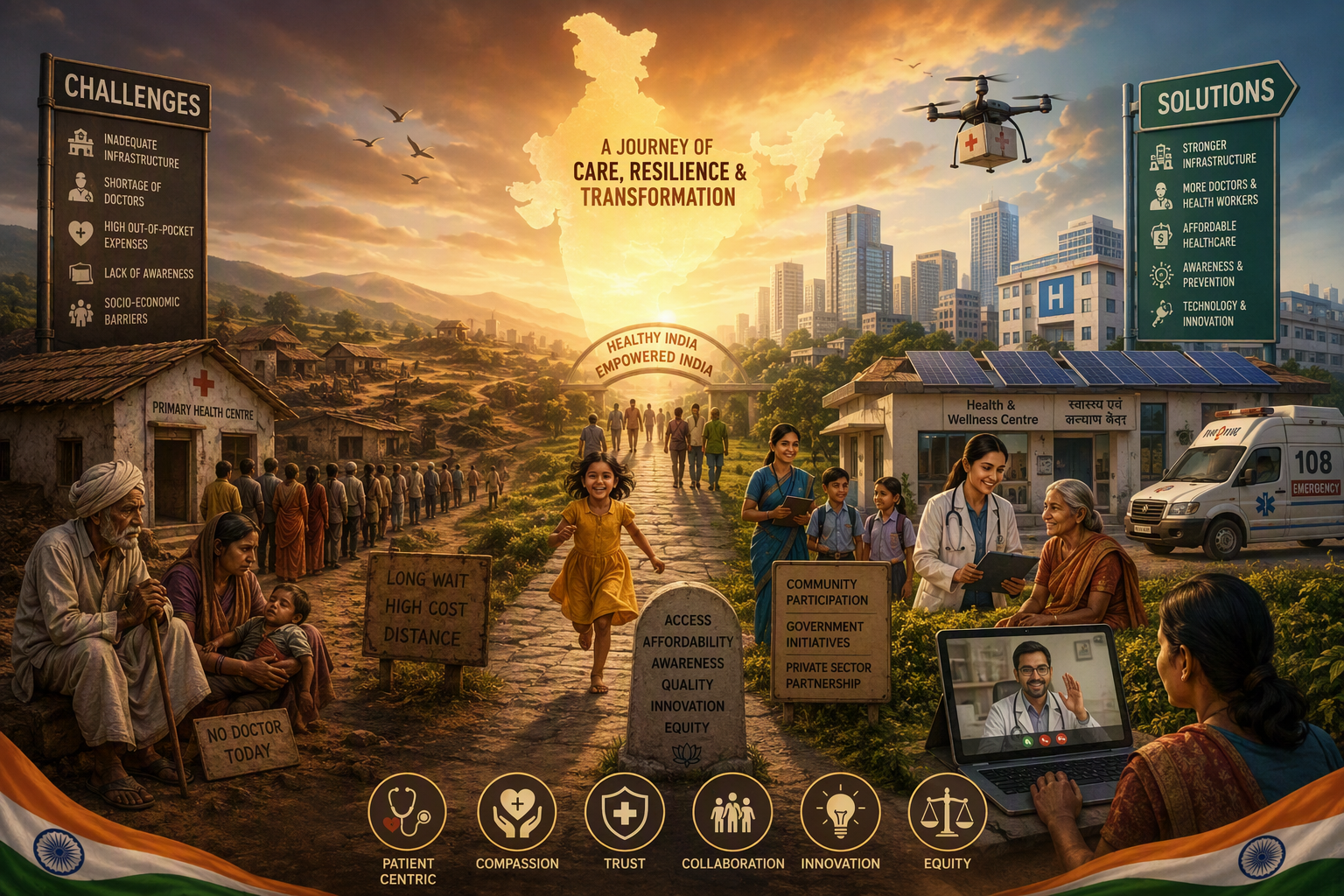
Key Highlights
- India’s healthcare system has big problems with access, staff, buildings, and making care affordable for all.
- Public health services reach a larger population, but the resources are often not enough.
- Rural areas do not have as many hospitals, doctors, medicines, and emergency care as urban areas.
- A lot of families still find it hard to get affordable healthcare because they have to pay high costs out of their own pockets.
- The healthcare sector in India can get better with new policies, steps for prevention, and better insurance options.
- Technology is helping provide quality healthcare through things like telemedicine, digital records, and health apps.
Table of Contents
Introduction
India’s healthcare system helps a large group of people with many backgrounds. But the system has trouble because not everyone can get care when they need it. Costs are going up, and some places do not have good service delivery. The healthcare sector is made up of both public healthcare and private groups, but not all people see the same benefits. People living in cities often get more choices for care. People in villages might have to travel far for help. To make india’s healthcare system better for all, we first have to know these problems.
Overview of India’s Healthcare System
India’s healthcare system includes both public healthcare and the private sector. Public healthcare is cheaper for many and helps a larger population. Private hospitals give faster care and have better tools, but they cost more. This difference in healthcare services affects how people get care in the country.
There has been some progress with government schemes like Ayushman Bharat. People now also use more digital tools. But the system still has some big gaps. The main problems are in the way care is available, easy to get, not too costly, and good enough for everyone. These issues are clear when you see how the system is set up and what the main goals are.
Historical Development and Structure
India’s healthcare system includes both government services and private options. Over the years, the Indian government set up a public health network. The idea was to help people from different areas and income groups. Because of this, India has public hospitals, clinics, and local health centers for people. The public health plan is now a big part of India’s healthcare system.
The private health sector grew fast. It is now a big part of medical care, mostly in cities. Many people go to private places when they want quicker help or special services. But the growth of the health sector also made a bigger space between those who can pay for care and those who cannot.
State governments play a key role in how the healthcare system works every day. They help run health services, public hospitals, and local care. This setup shows why the Five A’s are so important. Care might be there, but it is often not available, easy to get, affordable, acceptable, or good in quality.
Current Priorities in Indian Healthcare
Right now, the main focus is to make healthcare delivery better for people who have limited access. This is very important for those who live in remote and rural areas. The reason is that long travel, weak transport, and not enough medical staff make it hard for people to get help on time. These things often make health outcomes worse. If we reach more people, we can work to fix this problem.
Another clear focus is to make public healthcare better by giving more money, building more centers, and growing health insurance. Ayushman Bharat has helped many people by giving money help for health needs. But there are still many families that have to spend their own money for medicines, seeing a doctor, and hospital stays.
People are now paying more attention to preventive healthcare. Getting regular checkups, taking vaccines, keeping clean, and getting treatment early can help keep people out of hospitals. This also brings down the cost of care. Because of this, when people talk about public health policy, they often link things like giving more people insurance, public health education, and health mission plans. All of these work together in a bigger plan to improve care for everyone.
The Five A’s Framework: Understanding the Core Challenges
The Five A’s framework shows why there are still so many healthcare problems in India. It asks if care is there when people need it. It looks at whether people can get to the care. It checks if they can pay for the care. It finds out if the care helps their needs. It also asks if the quality care is something people can trust.
When you see things this way, the biggest problems show up. People in the countryside often have a hard time getting healthcare. A lot depends on how far they are from places that give quality care and what transport is there. A big problem is cost, as many families do not have the money for this. The quality care you get can also be very different in some places. These important problems are talked about in the parts below.
Availability of Medical Services Across India
Availability is about if healthcare services and basic healthcare services are really there when people need them. In India, this is very different in each place. Urban areas often have more hospitals, private clinics, experts, and places where you can get tests done. Rural areas have fewer buildings for health, and the supply of medicines and medical equipment is not as good.
This shortage has a big effect on daily care. There are many villages that do not have enough medical professionals. Some health centers do not have all the things they need. When services are not there, people have to wait for treatment. This makes health risks go up.
- Rural areas often do not have hospitals close by. They also do not have enough trained doctors or good emergency support.
- Urban areas have more medical professionals. They also have better tools and can give special care.
- A short supply of medicine and old buildings make it hard for many communities to get good service.
Accessibility Gaps Between Rural and Urban Populations
Accessibility means how easy it is for people to use the services that are already there. In many rural areas, there can be limited access because they are far away, there is poor transport, and not many ambulances. Even if there is a health center, the time it takes to get there can be hours. The cost to get there can also be more than what some families can pay.
Urban areas usually let people travel for a shorter time. There are also more choices for care, and this makes healthcare delivery better. This can change public health a lot. If people get care late, a common illness can become very serious. It can also put a bigger burden on families. They may have to travel far for the care they need.
| Factor | Rural Areas | Urban Areas |
|---|---|---|
| Distance to care | Health centers may be far from villages | Facilities are usually closer |
| Travel support | Ambulance and emergency options are limited | Better transport and faster emergency response |
| Care options | Fewer hospitals and clinics | More hospitals, clinics, and specialists |
| Impact | Delays, higher costs, worsening conditions | Quicker access and more continuous care |
Affordability of Care for Different Socioeconomic Groups
Affordability is still one of the main problems in India’s healthcare system. Public services do cost less. But, many people choose private hospitals because they want better or faster care. For low-income families, the cost of healthcare can go up fast. This can be a big money problem for them.
Health insurance can help to cover some costs, but health insurance coverage is still not the same for everyone. Government schemes like Ayushman Bharat have helped many, but there are still a lot of people who use their own money for medicines, visits to the doctor, travel, and hospital stays. This means that their healthcare expenditure at home goes up.
A good way to move forward is to lower direct costs and give more protection.
- Make health insurance coverage bigger so that more families can feel safe about money.
- Give help with costs and have stronger control on prices for treatments and essential medicines.
- Make public services close by better so people do not have to pay more for travel and staying somewhere else.
Issues Impacting Quality and Equity in Healthcare
Quality healthcare and being fair go hand in hand in the healthcare system of India. A person’s money or where they live should not decide what kind of care they get. If these things do, the healthcare system is not fair. That is why staffing, what buildings they have, and how much money goes into the system are so important.
Improving quality is not just about having modern equipment. It is also about the healthcare professionals, who must be trained well, treating people at the right time, and giving steady help for those who get less care. If you want to know where fairness fails, you need to look closely at the people who work in care and also the places where they work.
Challenges with Trained Healthcare Professionals
One big problem with India’s healthcare system is that there are not enough trained healthcare professionals. Many areas do not have enough doctors, nurses, or other medical personnel. This makes people wait longer, have delays in their treatment, and also means the quality is not the same everywhere.
The problem is bigger in rural and remote areas. Many medical staff want jobs in cities because there are better tools to use and the pay is higher. Because of this, people living in rural and remote areas may have to rely on general doctors. These doctors have less help and there are fewer treatment options for people there.
This is a human resources issue for the whole health sector. Better training and stronger staffing rules can help. A fairer way to place medical personnel across India will help too. If India wants equal care, it has to send healthcare professionals to places that need them most, not just to areas where the market is good.
Infrastructure Deficiencies and Overcrowded Facilities
Problems with infrastructure keep making healthcare weak across India. A lot of places do not have enough beds. The buildings are not always good. Many do not have basic things or new medical equipment. In public hospitals, these problems lead to crowded rooms. Staff feel stress all the time, and patients have to wait for care.
Private hospitals can give you nicer places to stay and quick help, but they cost a lot. Many people cannot pay these high prices. So, families have to make hard choices. They might need to wait longer to get help from the public system. Or they may feel forced to pay more than they can afford at private hospitals.
Better healthcare funding is where practical solutions begin. Public hospitals must get upgraded buildings and better equipment. They also need improved maintenance. If there is more room, crowding will go down. This will help keep people safe and give better service delivery. Good hospitals can offer better quality care. People will also trust the system more.
Healthcare Policy and Governance
Healthcare policy decides how the money is used, where people set up services, and who gets help first. In the healthcare sector of India, the Government of India and state leaders guide public healthcare. They do this with money, by making insurance programs, by setting rules for workers, and by starting plans to stop people from getting sick.
That is why policy reforms are important. They help to bring change. Good governance helps the country. It can help things be more fair. It can make local systems better. It can also cut down on waste or misuse.
To understand how this works, let us look at regulation. It is also good to look at how public and private care relate to each other.
Regulatory Oversight and Reforms
Regulatory oversight is important because the healthcare system will not get better without clear rules and good use of resources. In India, some healthcare problems happen when there is mismanagement, poor coordination, and rules are not put in place well. When money is not used the right way, people feel it in many ways, like poor facilities and services that are not there.
Policy changes can fix these gaps. We need better planning. There should be closer checks as well. It is also good to have clear accountability. These steps can make sure public hospitals, clinics, and government schemes do what is promised. This matters a lot in places where people have few options for care.
Policy has a useful and protective role. It helps guide staffing, building needs, insurance expansion, and preventive care efforts. If leaders keep their work centered on fairness, openness, and good service delivery, they can make access better for people and also raise the quality at the same time.
Public vs. Private Sector Roles and Collaboration
The difference between public healthcare and the private sector is a big part of how people get care in India. Public healthcare costs less and helps a lot of people who might not get care otherwise. The private sector gives faster care, newer tools, and more types of help for health needs. Both of these systems are needed, but each one has things it cannot do.
Progress happens when people see that healthcare delivery gets better if the private and public sectors work together. These two should not work alone. When public and private groups team up, they can help fill the gaps. This is true when the government’s hospitals are too busy, and when private care costs too much for families. Working together is the way to make healthcare delivery better for all.
Useful areas for partnership include:
- The upgrade of public facilities can happen when support is shared for things that the public uses.
- When there are joint programs, service delivery can get better in places that do not have many services now.
- Prices can stay low if private companies and public leaders work together and keep the same goals.
Innovations and Technology in Transforming Indian Healthcare
There is now more innovation in the healthcare sector in India. Digital health tools help make things better. They can shorten the distance, save time, and help everyone get better care in an easy way. This is very important in places where it is hard for people to get to doctors, or where hospitals and clinics are not close by.
Technology can help us make better choices in health care. There are digital records and remote consultations now. These can make services faster and the same every time. When you use this new tech with good medical equipment and strong systems, you get a real chance to help more people at one time. This way, better care can reach more people.
Digital Health Initiatives and Telemedicine
Digital health can make it easier for people in remote areas to get care. Telemedicine lets patients talk to doctors without a long trip. This can help save money. It also cuts down on wait times and gives people advice from doctors when there may not be a specialist near them.
Digital health records help make treatment more organized. When the patient details are kept in order, the doctor can check history quickly. This helps cut down avoidable mistakes. Health apps and mobile health apps also help people keep track of their medicine, what they eat, and their regular health needs.
Innovation is important because it helps to get to more people and makes things work better. It can help a business or group work in a good way. When you use new ideas, you can reach out to more people, and do what you need to do in less time. This is why many say that innovation should be part of every workplace.
- Telemedicine helps people who live far from hospitals talk to doctors.
- Digital health records let the provider get patient history quick and easy.
- Health apps help people with follow-up care. There are reminders and you can use the app for simple self-monitoring.
Implementing Evidence-Based Practices
Evidence-based practices are using good and reliable knowledge to help care for people, instead of using guesses or old habits. In India, this way of working can make quality care better. It helps medical professionals pick treatment options that are safer, work well, and are the same in different places.
There is a real chance to make things better here because the system is already looking at digital tools, stopping problems before they start, and stronger policy help. When people who give care can get to patient history, use standard steps, and get better training, they can make better choices. That means there will be fewer mistakes and health outcomes will get better.
This also helps make things more fair. If the care you get is based on what works and not where you live or how much money you have, more people will get good treatment. Evidence-based practices work best when there is staff who know what to do, working buildings and tools, and systems that help people feel sure about the care they give.
Vision for the Future: India’s Healthcare by 2047
India wants to build a more inclusive healthcare system. The plan is to give every person good care, no matter where they live or how much money they have. It’s not just about having more hospitals or starting more programs. India is working toward a healthcare system that people can use, that does not cost much, and that they can trust.
For the health sector, there needs to be steady money put into new things like buildings and tools. It is also important to work more on stopping sickness before it starts, grow insurance for more people, and use better technology. The way forward to 2047 is to take the changes we have now and build them into systems that can help all people for a long time.
Roadmap to Universal Healthcare Coverage
A real plan to reach universal healthcare starts by giving more healthcare access to people in places that do not have enough. People living in villages and far-away spots need health centers near them. They also need mobile help and support for referrals. This way, they can get care without having to travel all the time.
Affordable healthcare is the next big need. The Ayushman Bharat and Pradhan Mantri Jan Arogya Yojana plans help move India to more health support. Even with this, many families still pay medical bills on their own. If more people get covered and it is easier to get help, there will be less money stress for them.
Universal healthcare needs better public systems. It is not enough to have insurance if the services are not there or if hospitals are too full. For India’s 2047 vision, it is important to put together coverage, buildings, and steps to stop illness. This way, families can get care when they need it, and they will not go into debt or miss out because of where they live.
Strategies for Enhancing Equity and Quality
Equity gets better when the system gives more help to people who have the hardest challenges. In India, this means there needs to be stronger support for rural groups, low-income people, and those who have limited access to regular services. Quality healthcare should be steady and reliable everywhere. It should not just be in a few places that already have good services.
Prevention is a key part of fairness. When people get screenings on time, get vaccinated, learn about hygiene, and get early advice, they often do not need expensive care in an emergency later. Having good health insurance and access to essential medicines can help make this way of taking care of health better for everyone.
Key strategies include:
- We want to increase preventive care and share health education in areas that do not get enough help.
- We work to make health insurance easier for everyone to get. This way, getting treatment will not put people in a bad spot with money.
- We make sure public places have all the essential medicines and basic equipment they need.
Conclusion
India’s healthcare system is facing some big problems. These need quick action and smart plans to fix. There are issues with how people get care and how good that care is. Fixing these problems is key if we want everyone to be healthier in the years to come.
New ideas like digital health and telemedicine can change healthcare delivery. They can make it faster and easier for people to use. When we think about India’s healthcare system by the year 2047, it’s clear that people in both the public and private sectors need to work together.
We need to give attention to fairness, price, and quality. By doing this, we can bring about an inclusive healthcare system that works well for everyone. All of us can help build a healthcare system in India that is strong and helps all the people to be healthier.
What are the main challenges facing India’s healthcare system today?
India’s healthcare system has several problems. People who live in rural areas often have limited access to care. The cost to get treatment is high for many families. In a lot of places, the hospitals and clinics do not have good buildings or enough space, so these places become overcrowded. There are not enough trained staff, which adds to the problem. All these issues hurt public health. They also make the healthcare system unfair, especially for people who are far from help or do not have money for private treatment.
How can India improve access and affordability of healthcare?
India can make affordable healthcare better by growing health insurance coverage for more people. The government can also make its schemes stronger to help more families. Building new local health centers where people live will help more people get care easily.
Using telemedicine and mobile clinics can help more people see a doctor when they need to. If medicine costs are lower, people will face less money troubles. These steps will help families get help on time and not feel big financial stress.
Keywords used: health insurance, health insurance coverage, government schemes, affordable healthcare
What role does innovation play in India’s healthcare future?
Innovation can make the healthcare sector better for everyone. It can help more people get good medical services. The use of digital health tools, telemedicine, mobile apps, and digital records can help a lot. With these, people do not need to go far for help. They can talk to doctors faster and keep getting care. This is good for those who live in faraway or hard-to-reach places in India.